
Step 2: Correcting Grammar Mistakes
Watch the video below.
Correcting Grammar Mistakes
- Decide if you should immediately correct or not.
- Small mistake – correct immediately
- Student: I have ever been there.
- Teacher: I have never been there.
- Big mistake – make a mental note and wait for a break – don’t interrupt the student
- Student: If I were rich, I would happier than I am now.
- Teacher: *waits*
- Small mistake – correct immediately
- Write down the error on the “You said, You should say” section of your sheet.
- You said You should say
- I live in downtown
- do not fill out the “you should say” part yet.
- Try to elicit the correct form from the students in the class.
- Teacher: “Does anyone know what’s wrong with ‘I live in downtown'”?
- Write the correction in the “You should say” section.
- You said You should say
- I live in downtown I live downtown
- Ask the students if anyone knows what the difference is.
- If nobody answers (which is likely) write down some notes in the Grammar section while they are thinking.
- downtown
- in downtown
- Explain the reason why it is incorrect and add it to your notes
- downtown (Adverb) – can’t use in
- I run in quickly (incorrect)
- I live in downtown (incorrect)
- I live downtown (correct)
- I work downtown (correct)
- downtown (Adjective) – can use in with a noun
- I live in beautiful (incorrect)
- I live in downtown (incorrect)
- I live in beautiful Vancouver (correct)
- I live in downtown Tokyo (correct)
- downtown (Adverb) – can’t use in
- Return to the “You said / You should say” section and ask students if they now understand why it was incorrect.
- Ask each student for an example with the target grammar. Correct where necessary.
- Teacher: “Can you use downtown in a sentence?”
- Student 1: “I live in downtown New York.”
- Student 2: “I live downtown Paris”
- Teacher: “I live……”
- Student 2: “I live in downtown Paris”
- Teacher: “Bien!”
Common Grammar Mistakes in Conversation Class
- a/the
- a = one of many
- He is a student in the class.
- the = one of one
- Shaun is the teacher in the class.
- a = one of many
- positive + negative questions = same answer
- Are you
- A: Are you hungry?
- B: Yes I am.
- Aren’t you
- A: Aren’t you hungry?
- B: Yes I am.
- Are you
- have been + experiences, past tenses + time
- past tense + time
- I went to Australia last year.
- have + pp for experiences
- I have been to Australia
- past tense + time
- will & going to
- will = making a decision at the moment
- I’ll get an ice cream because it’s hot.
- going to = pre-planned
- I’m going to Hawaii on Monday
- will = making a decision at the moment
- Maybe, might, may
- Maybe = one word answer
- A: Do you like me?
- B: Maybe.
- Might/may = possible
- I might/may go to the party tonight.
- Maybe = one word answer
- On my own, by myself and alone
- By myself = without anybody else and happy
- I live by myself, I love not having a roommate.
- Alone = without anybody else and sad
- I had dinner in a fancy restaurant alone on Valentines day.
- On my own = strong enough to do it without help
- For the first time, I went hiking alone.
- By myself = without anybody else and happy
- almost all + noun
- almost all means “most” but not 100%
- Almost all Japanese people like sushi.
- almost all means “most” but not 100%
- during and while
- during = action + time
- I studied during the summer.
- while = 2 actions at the same time
- It rained while I played tennis.
- during = action + time
Class Notes Examples
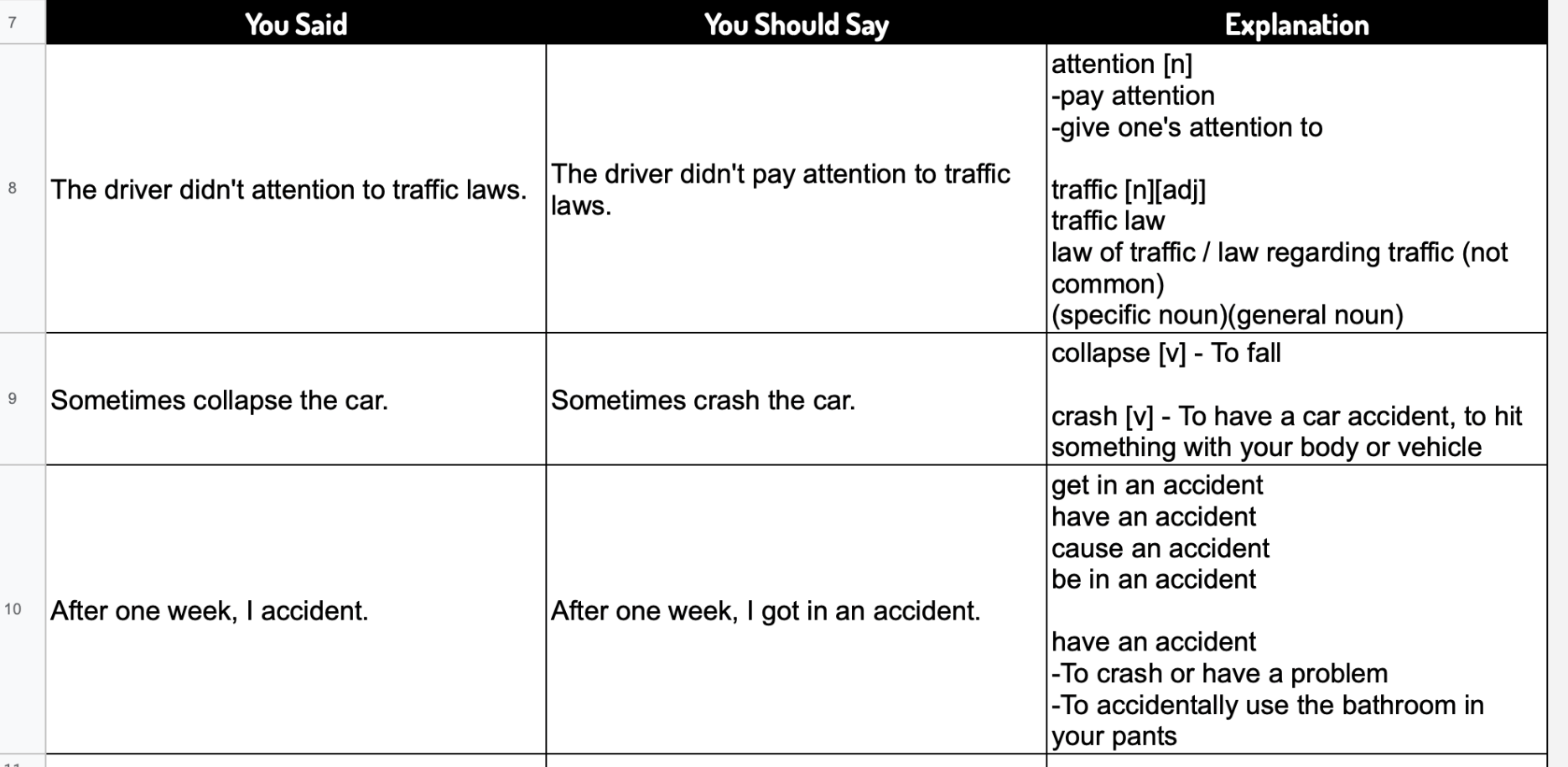
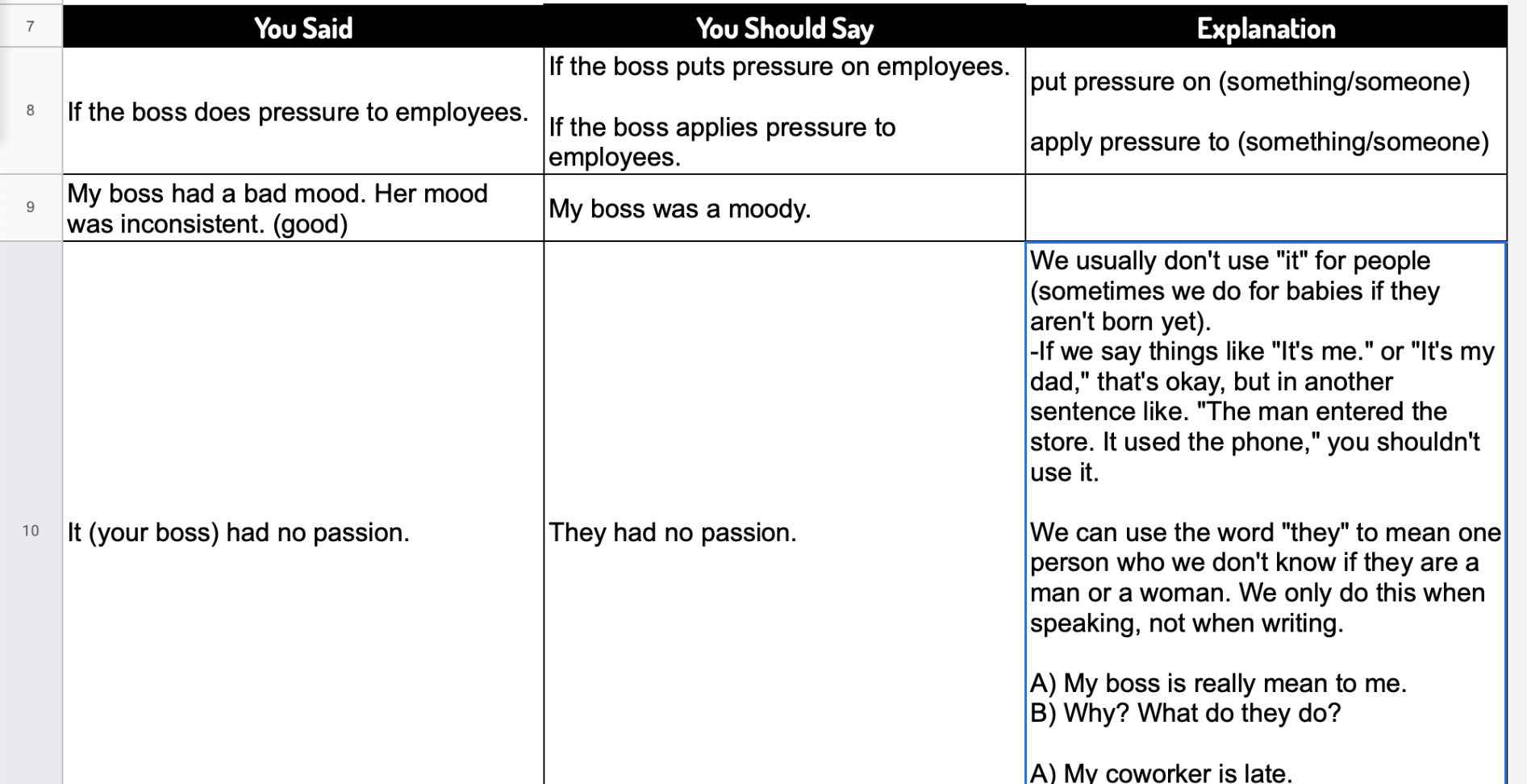
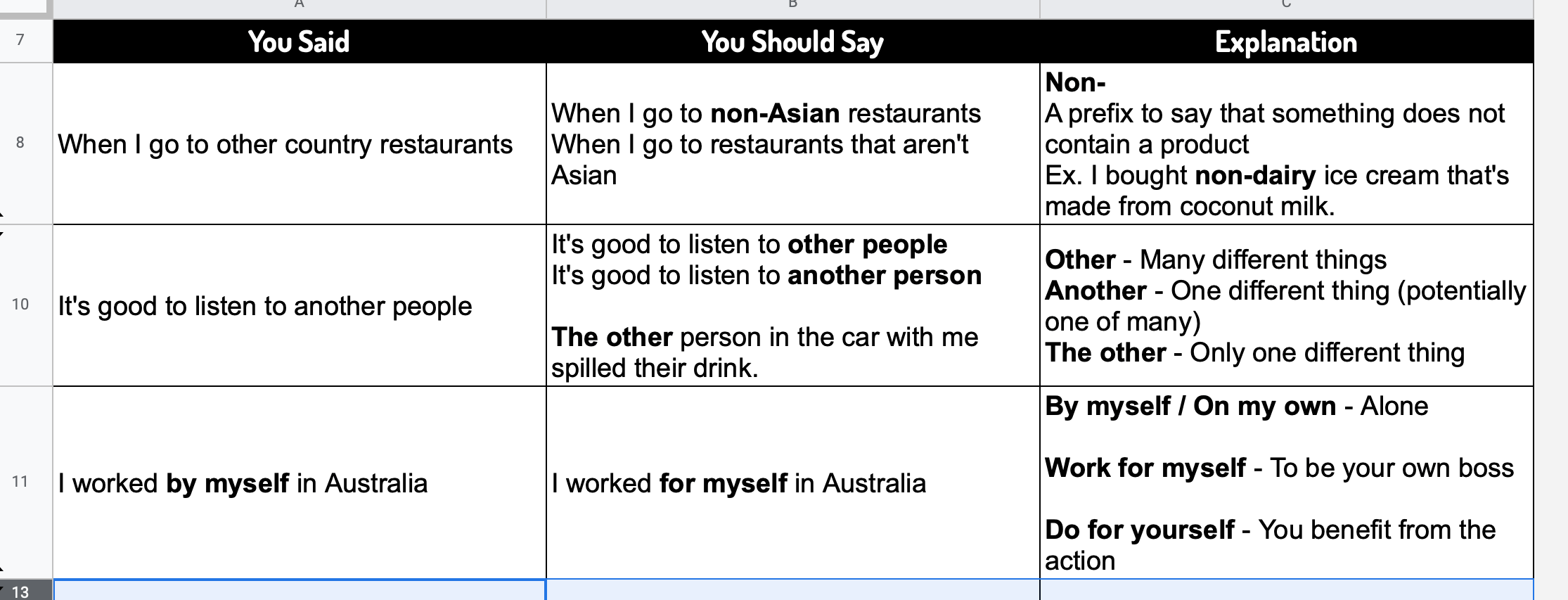
Grammar mistake corrections should look like this.